
Does a Fresh Coat of Paint Actually Help Your Home Sell? A Charlotte REALTOR® Breaks It Down
Does painting your home before listing increase sale price?
Yes — in most cases, a professionally executed pre-listing paint job delivers measurable ROI. Exterior repaints consistently rank among the highest-return pre-sale investments, with some industry analyses citing returns exceeding 100% of project cost. Interior neutral repaints reduce buyer objections, help online listing photos perform better, and shorten average days on market. The key is strategic scope: not every room needs a refresh, and the wrong color choices can work against you.
If you've ever asked a real estate agent whether you should paint before listing, you've probably gotten a vague answer like "it depends." That's technically true — but it's not very useful when you're trying to make smart decisions with your time and money before your home hits the Charlotte MLS.
I'm Carnarri Cofield, a licensed REALTOR® with Citadel Cofield serving buyers and sellers across the Charlotte metro and Carolinas region. I've walked hundreds of pre-listing consultations, and paint comes up in nearly every one of them — sometimes as a question, sometimes as an urgent fix, and occasionally as the single thing standing between a seller and their target price.
M.A. Painting LLC, based right here in Pineville and serving the Weddington area and surrounding communities, asked me to put together a practical guide for homeowners thinking through this decision. So here it is — the real estate side of what painters like M.A. Painting execute every day.
Why Paint Delivers Outsized ROI Compared to Other Pre-Listing Projects
Before we get tactical, let's talk about why paint specifically earns such consistent attention in pre-listing prep conversations.
When buyers tour a home — in person or through listing photos — paint is one of the most immediately visible signals of how well a property has been maintained. Scuffed baseboards, faded exteriors, and dated accent walls don't just look worn. They create a psychological opening for buyers to mentally discount the price and mentally inflate their renovation budget.
The National Association of Realtors' Remodeling Impact Report has repeatedly found that interior painting ranks among the top projects sellers undertake, with a high percentage of agents citing it as a contributing factor in faster sales. Exterior painting consistently registers even higher in perceived value — particularly in the Charlotte market, where a home's first visual impression is formed before a buyer ever opens the front door.
More importantly, paint is scalable. Unlike a kitchen renovation or HVAC replacement, you can strategically scope a pre-listing paint project — targeting only the rooms and surfaces with the highest buyer visibility — and control costs while still moving the needle on perceived value.
Exterior Paint and Curb Appeal: What Charlotte Buyers Notice Before They Step Inside
In the Charlotte metro, a significant share of buyer activity begins online. A buyer decides whether to schedule a showing based on a listing photo taken from the street. That makes your home's exterior paint condition a direct driver of showing volume — which is a direct driver of offer activity.
Here's what buyers (and their agents) are evaluating from the curb:
Trim condition.
Peeling or chalking trim — especially around windows, fascia boards, and garage door frames — reads as deferred maintenance. Buyers trained by their own agent (and by years of HGTV) will factor that into their offer.
Front door color.
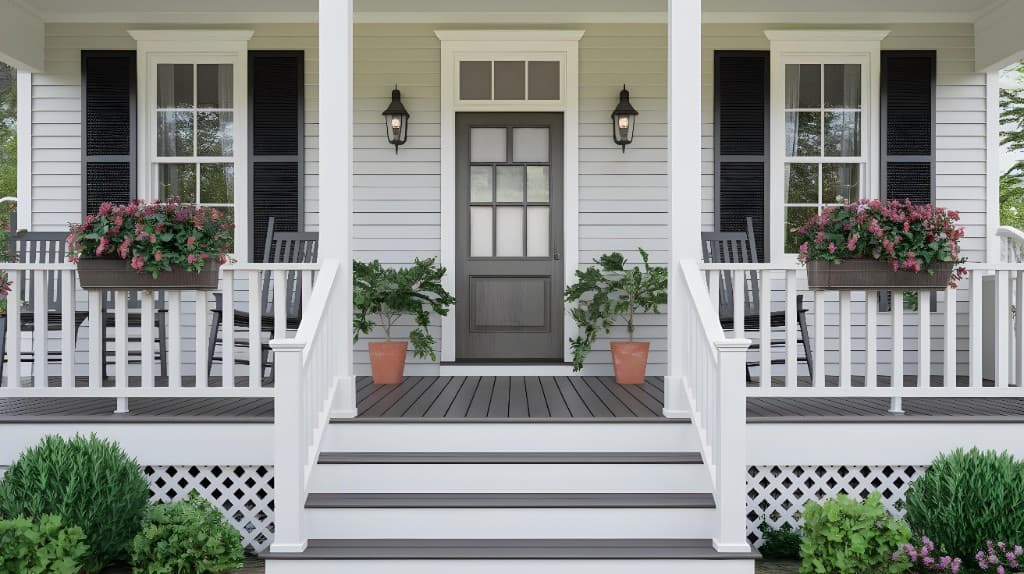
The front door is the one place where color personality is acceptable, even desirable, in pre-listing prep. Zillow's consumer research has repeatedly flagged black and charcoal front doors as associated with higher buyer interest relative to neutral alternatives. A fresh, bold door color on an otherwise neutral exterior is a low-cost, high-impact decision.
Brick and siding consistency.
In Charlotte's older stock — particularly ranch homes and split-levels in communities that were built from the 1960s through the 1990s — exterior paint inconsistencies from previous patchwork repairs are common. A full exterior refresh unifies those variations and removes what would otherwise become a negotiating point.
Driveway and hardscape framing.
Paint doesn't exist in isolation. A crisp exterior paint job paired with overgrown landscaping or a cracked driveway creates cognitive dissonance. The paint upgrade raises the bar for everything around it — which is why pre-listing curb appeal prep should be coordinated, not siloed.
If you're working with a local contractor like M.A. Painting for your exterior refresh, ask specifically about surface prep: cleaning, scraping, and priming. A rushed exterior paint job that skips prep will bubble and peel within a season, which is a liability if your sale doesn't close immediately.
Interior Paint Strategy: Neutral Doesn't Mean Beige and Boring
The standard advice — "paint everything a neutral gray" — is partially right but often misapplied. Here's a more precise framework:
The goal isn't neutrality for its own sake. The goal is maximum buyer applicability.
That means choosing tones that:
- Photograph well under standard listing photo lighting conditions
- Feel cohesive across the home's floor plan when seen in sequence
- Don't compete with fixed elements like countertops, cabinetry, or flooring
In practical terms for Charlotte homes right now, warm greige tones (think Sherwin-Williams Accessible Beige, Agreeable Gray, or Benjamin Moore Pale Oak) consistently outperform cool blue-grays, which can read as flat or cold in listing photos — especially in homes with limited natural light.
Rooms that always warrant a refresh before listing:
- Living room and main open-concept areas (highest buyer visibility, most photographed)
- Primary bedroom (emotional anchor room for buyers)
- Kitchen, if walls are visible around cabinets
- Any room with a bold or highly personalized color that narrows buyer pool
Rooms where a refresh is situational:
- Secondary bedrooms in good condition
- Finished basements, unless they're being marketed as a primary selling feature
- Laundry rooms and utility spaces
Where sellers waste money:
Painting rooms that are in acceptable condition simply to say "the whole house was freshly painted" rarely moves the needle. Buyers and their agents will notice the strategic high-visibility rooms far more than a basement utility room with a fresh coat.
One additional note: if your home has wallpaper — particularly in bathrooms or accent walls — address it before painting. M.A. Painting offers wallpaper removal as part of their service offering, which is worth handling before any paint goes on those walls. Painting over wallpaper is a shortcut that buyers' home inspectors and observant agents will flag.
How to Time Your Pre-Listing Paint Project
Timing is where sellers most commonly make avoidable mistakes. Here's a practical sequencing framework:
- 6–8 weeks before listing: Conduct your pre-listing consultation. Walk the home with your agent and identify the specific rooms and surfaces that need attention. Get two or three contractor bids, including your exterior if applicable.
- 4–5 weeks before listing: Begin exterior work first (weather-dependent in the Charlotte area — late fall and winter projects need flexible scheduling). Interior work can proceed in parallel if the home is occupied, room by room.
- 2–3 weeks before listing: Interior paint should be complete and fully cured. This matters: freshly painted rooms that haven't cured fully will off-gas during showings, and some buyers are sensitive to that.
- 1 week before listing: Staging, photography, and final touch-ups. Your listing photographer will thank you — freshly painted spaces photograph significantly better than worn or dated interiors.
The contractor relationship matters here. For sellers in the Weddington, Pineville, Ballantyne, and surrounding Charlotte-metro communities, working with a local contractor like M.A. Painting — who understands the regional housing stock, schedules efficiently, and operates with a professional crew — is a material advantage over the delay and variability risk of scheduling a contractor cold.
What Charlotte-Area Sellers Get Wrong About Pre-Listing Prep
Mistake 1: Over-improving.
Pre-listing prep has a ceiling. The goal is to remove buyer objections, not to renovate. If a home needs $2,500 in painting and a seller spends $18,000 on a full interior renovation on top of that, the incremental return diminishes sharply. Paint is one of the few pre-listing investments with a favorable cost-to-return ratio precisely because it's contained.
Mistake 2: DIY-ing high-visibility surfaces.
Listing photos are professionally shot, zoomed, and enhanced. A DIY paint job with roller marks, uneven cut-ins, or mismatched touch-up patches will show up in those photos — and buyers will notice. High-visibility rooms deserve professional execution.
Mistake 3: Ignoring the front door and trim.
Sellers often budget for interior rooms and skip the exterior because it feels less urgent. But the sequence of buyer perception always starts outside. If the exterior signals deferred maintenance, buyers arrive at the front door with skepticism already primed.
Mistake 4: Choosing colors based on personal preference.
It's your home — until it's not. Once you're in selling mode, color decisions should be made on the basis of buyer psychology and listing photo performance, not personal taste. This is an area where an experienced agent can add real value by guiding the color selection conversation with market data rather than opinion.
What Buyers Should Know About a Home's Paint Condition
If you're on the buying side of a transaction, paint condition is a useful diagnostic tool — not just an aesthetic concern.
Exterior paint condition reveals maintenance history.
A home with significant exterior peeling, chalking, or wood rot beneath the paint surface may have deferred maintenance that extends to other systems. Your home inspector will assess this, but a visual scan of paint condition during your showing is a useful first filter.
Interior paint can mask or reveal moisture issues.
Fresh paint on basement walls or around windows doesn't always mean the surface is in good condition. Bubbling, staining beneath fresh coats, or heavily textured "skim coat" patches over large areas warrant closer inspection.
Recent paint is not always a selling point.
A home where the seller painted immediately before listing but deferred other maintenance is a pattern your agent should help you identify. Fresh paint on a well-maintained home is a positive signal. Fresh paint on a home with unresolved mechanical issues is a cosmetic layer over a deeper conversation.
As a buyer's agent, part of my role at Citadel Cofield is to help buyers read these signals accurately — so they're not buying someone else's deferred maintenance at full asking price.
Frequently Asked Questions: Pre-Listing Paint in Charlotte, NC
How much does it cost to paint a house before selling in Charlotte, NC?
Interior costs vary by square footage, number of rooms, and surface condition, but a typical 2,000–2,500 sq. ft. Charlotte home can expect to invest $2,500–$5,000 for a professionally executed interior refresh targeting high-visibility areas. Exterior repaints for comparable homes typically run $3,000–$6,500 depending on siding type, prep requirements, and stories. Get at least two bids and ask specifically what's included in prep.
Does painting increase home value?
Paint itself doesn't add square footage or structural value, but it directly affects buyer perception — which drives offer price and competing offer activity. Industry data consistently shows that pre-listing paint projects have among the highest perceived ROI of any cosmetic pre-sale investment. The return isn't from the paint itself; it's from the buyer psychology it influences.
What colors sell homes fastest in the Charlotte market?
Warm neutrals in the greige spectrum — lighter tones that photograph well and don't compete with flooring or cabinetry — consistently perform in Charlotte's resale market. Avoid highly saturated accent walls in main living areas. Reserve color expression for the front door, where it reads as intentional rather than dated.
How long before listing should I paint my home?
Allow a minimum of two to three weeks for interior paint to cure before listing photography. Exterior work should be completed at least one week before photos. In practice, beginning the process six to eight weeks before your target list date gives you adequate scheduling runway and avoids the cost premium of rushed timelines.
Is it worth painting a house before selling if the market is hot?
Yes — arguably more so in a competitive market. In a hot market, sellers often skip pre-listing prep under the assumption that demand will compensate. Buyers in competitive markets are still comparative: a well-presented home draws more showings, more competing offers, and frequently achieves a higher final sale price than an equivalent home with visible deferred maintenance.
Work With a Team That Knows Both Sides of the Transaction
Pre-listing prep decisions don't happen in isolation. The right paint project is scoped against your target list price, your timeline, and the specific buyer activity in your submarket at the time you're selling. Getting that scoping right is the difference between a strategic investment and money spent for its own sake.
Selling in the Charlotte metro? Citadel Cofield offers pre-listing consultations for sellers across the Charlotte region, including the Pineville, Weddington, Ballantyne, and surrounding communities that M.A. Painting serves every day. We'll walk your home, identify the highest-impact prep priorities, and give you an honest assessment — including when not to spend more.
Buying in the Charlotte area? Our team helps buyers evaluate not just a home's cosmetic presentation but what's underneath it — so you make a confident, informed decision.
About the Author
Carnarri Cofield is a licensed REALTOR® with Citadel Cofield, a boutique real estate firm serving buyers, sellers, and investors across the Charlotte metro and broader Carolinas region. Citadel Cofield specializes in helping clients navigate complex transactions with clarity, strategy, and market-specific insight.
Guest post from our real estate partner Carnarri Cofield at Citadel Cofield (citadelcofield.com)